The CBUAE AI Guidance Note on Generative AI: What UAE Banks Must Govern Before the Agents Show Up
Look. The government next door just told everybody it is going AGENTIC. Fifty percent. In two years.
And your bank? Your bank is running a generative AI chatbot on a governance file nobody has opened since the pilot. SAD!
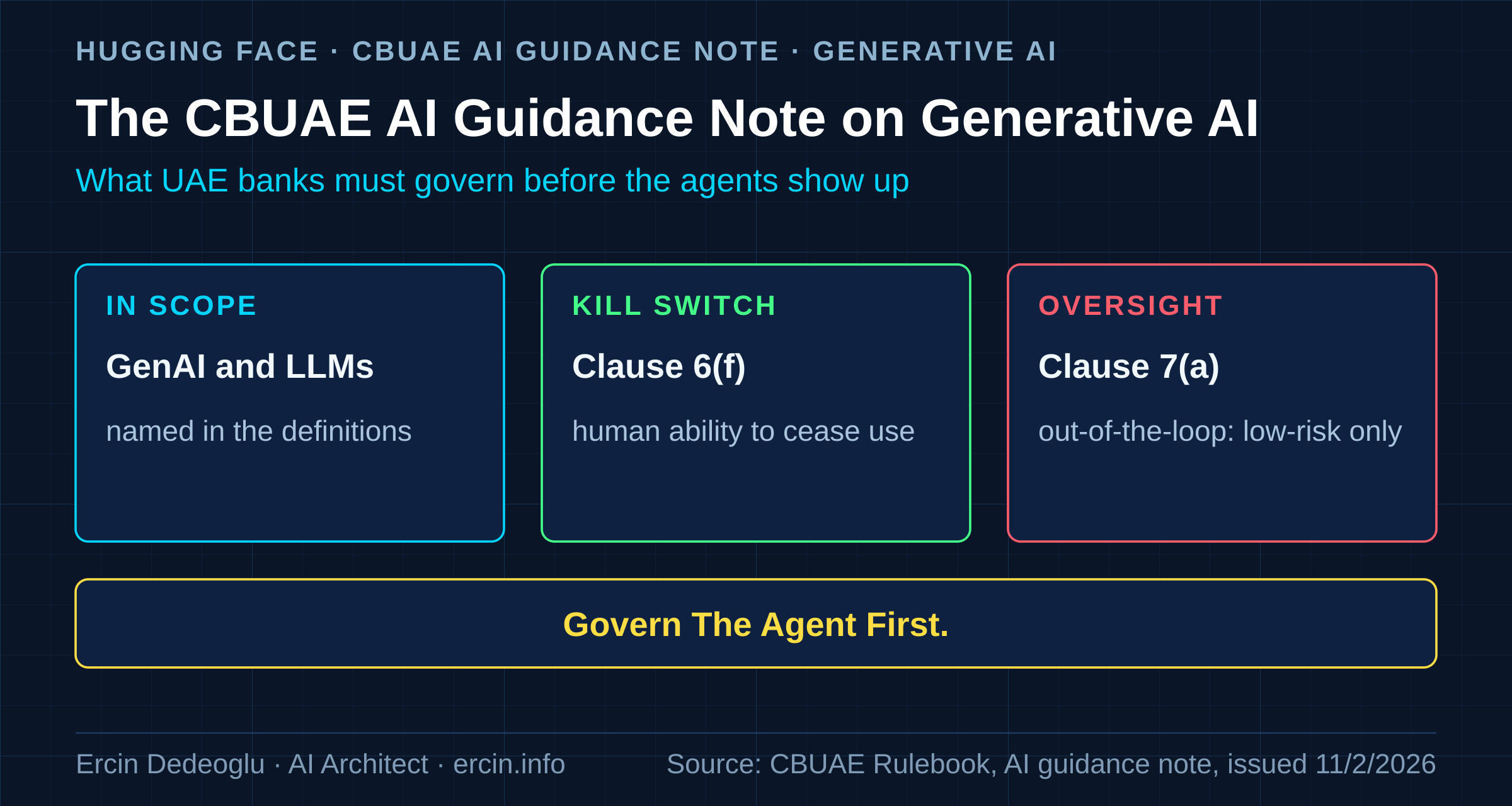
Here's the hard constraint you cannot escape. The Central Bank of the UAE already wrote down what it expects from every licensed financial institution that uses AI. Generative AI included. Large language models included. By name. It's called the Guidance Note on the Consumer Protection and Responsible Adoption and Use of Artificial Intelligence and Machine Learning, and the CBUAE Rulebook says it was "Issued on 11/2/2026" [1]. The press release came on 23 February 2026 [2].
So here's the WHOLE map. What the note says about generative AI, what matters for agents (it never says "agent"), and a checklist for Monday. Govern The Agent First.
Does The CBUAE Note Even Cover Generative AI?
Yes. Totally. No wiggle room.
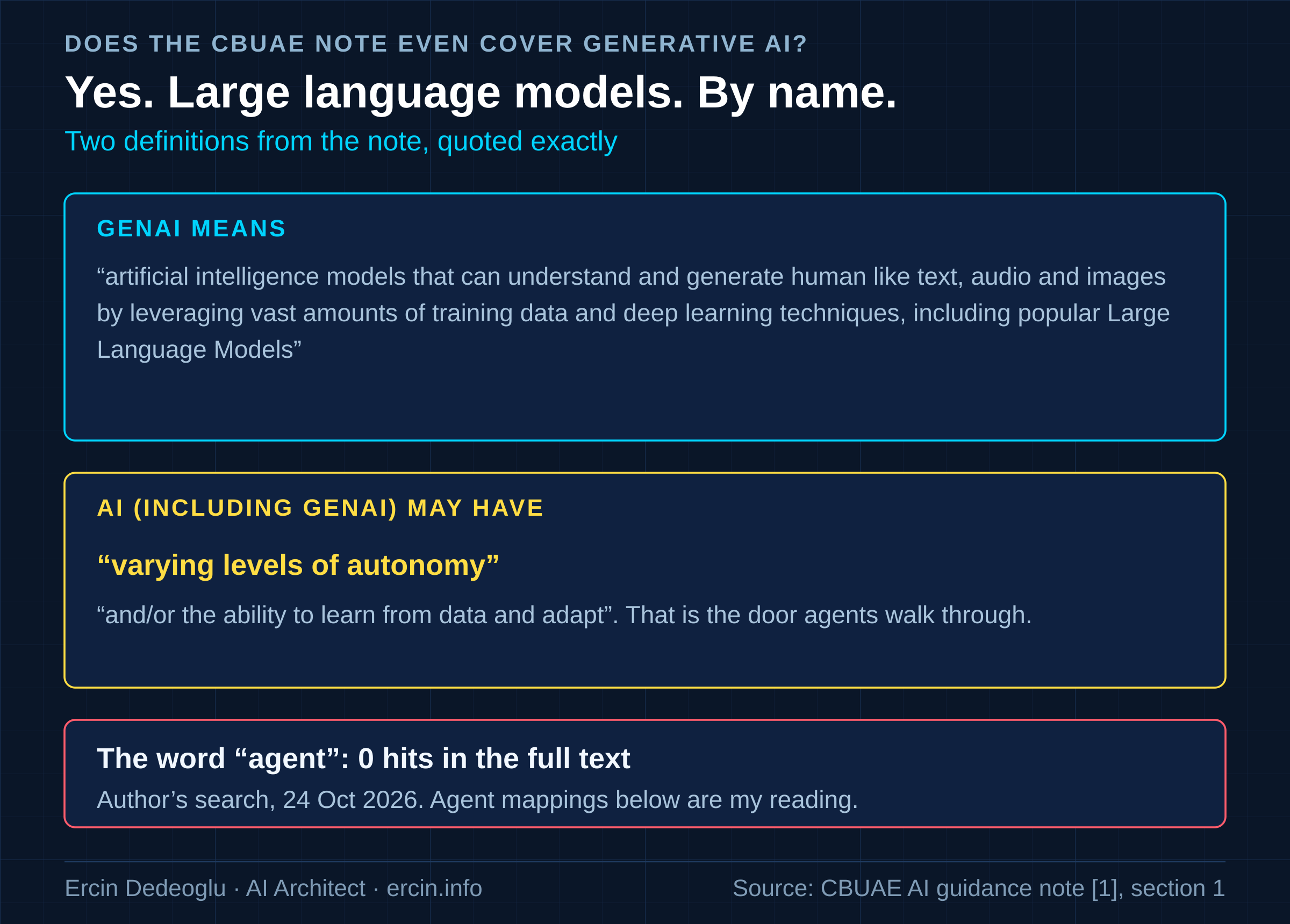
The note defines GenAI as "artificial intelligence models that can understand and generate human like text, audio and images by leveraging vast amounts of training data and deep learning techniques, including popular Large Language Models" [1]. And its definition of AI itself covers systems "which may have varying levels of autonomy and/or the ability to learn from data and adapt" [1].
Varying levels of AUTONOMY. Read that twice. That is the door agents walk through.
Now the honest part. The note is "focused on areas that may have bearing on consumers" and "shall supplement and not replace any laws, regulations or directives" [1]. I searched the full text. The word "agent" does NOT appear. So when I say an agent control "maps to" a clause, that's my reading, not the CBUAE's words. Anybody who says the note "requires" an agent gateway? WRONG!
What Does The Note Actually Ask For?
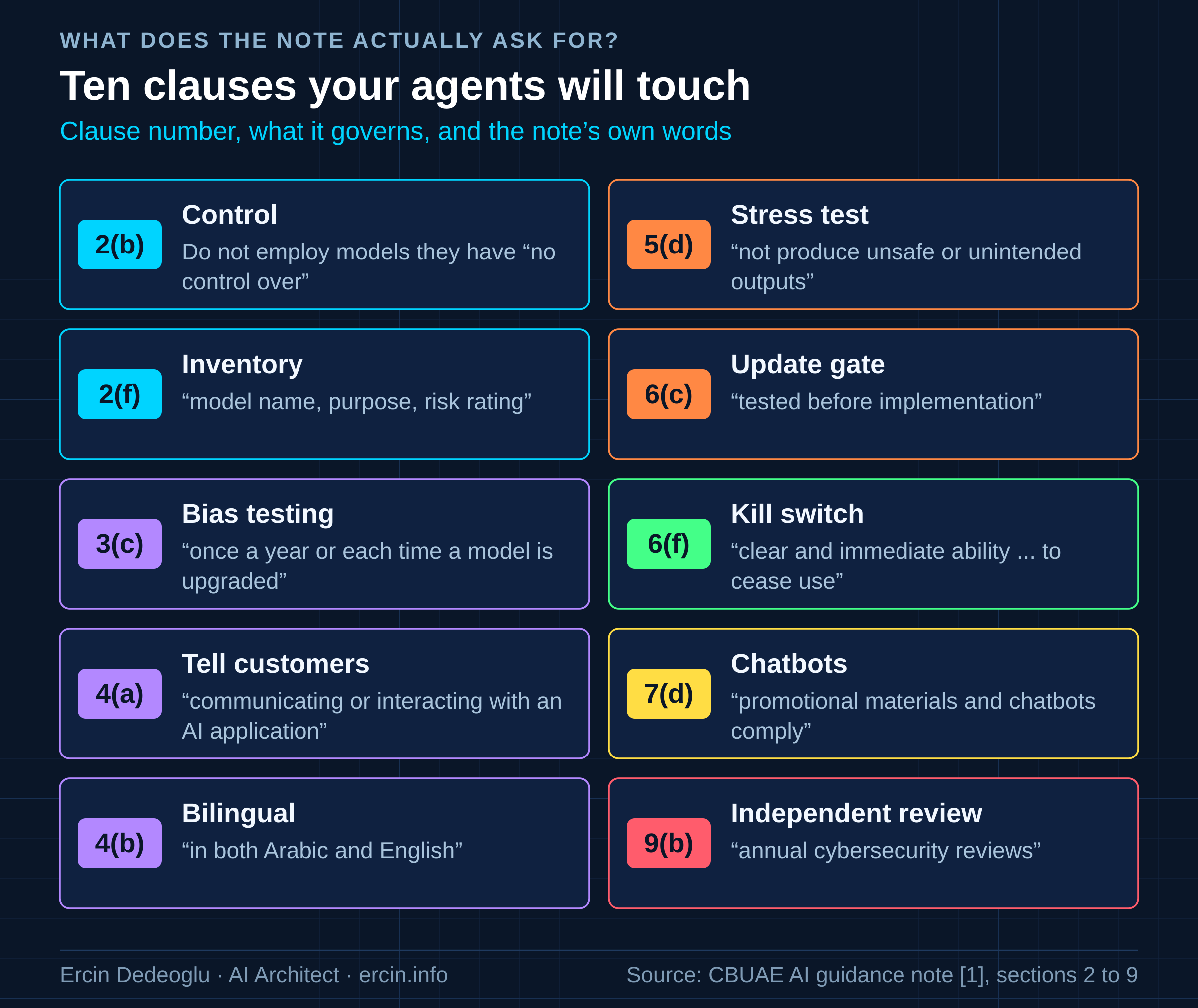
Frankly, more than most "AI strategies" I've seen. The clauses that bite hardest for generative AI, exact wording [1]:
| Clause | Exact wording (excerpt) | Why a GenAI team should care |
|---|---|---|
| 2(b) | "LFIs should not employ AI models that they have no control over." | A hosted model you cannot pin, log or stop is a problem. |
| 2(f) | Inventory to include "as a minimum model name, purpose, risk rating" | Every model, every assistant, every copilot. Listed. |
| 3(c) | Periodic testing "once a year or each time a model is upgraded, materially changed or a new one is introduced" | Model swaps are not free. |
| 4(a) | Be transparent "if they are communicating or interacting with an AI application" | Customers must know it's a bot. |
| 4(b) | Disclosures "in both Arabic and English" | Bilingual. Not optional in spirit. |
| 5(d) | AI "should be subject to stress testing and validation" so it does "not produce unsafe or unintended outputs" | That's red teaming in plain clothes. |
| 6(c) | "automatic updates their AI tools are tested before implementation" | Silent provider updates? Test them first. |
| 6(f) | "the clear and immediate ability, with human intervention, to cease use" | A real kill switch. Tested. |
| 7(d) | "promotional materials and chatbots comply with disclosure requirements" | The only place the note names chatbots. |
| 9(b) | "annual cybersecurity reviews by independent and suitably qualified third parties and pre-deployment tests" | For third-party AI providers. Every year. |
BTW, "red teaming" isn't in the note either. But 5(d) asks for stress testing against unsafe or unintended outputs, and 6(b) says independent experts "willing to challenge and question the use of AI" should be engaged periodically [1]. I wrote the long version on LLM red teaming for banking in the UAE. For a clause by clause map from the note to LLM test activities and evidence, see CBUAE AI guidance note: generative AI testing.
Why Is Agentic AI Governance In UAE Banks Suddenly Urgent?
Because the pressure is coming from EVERY direction at once.
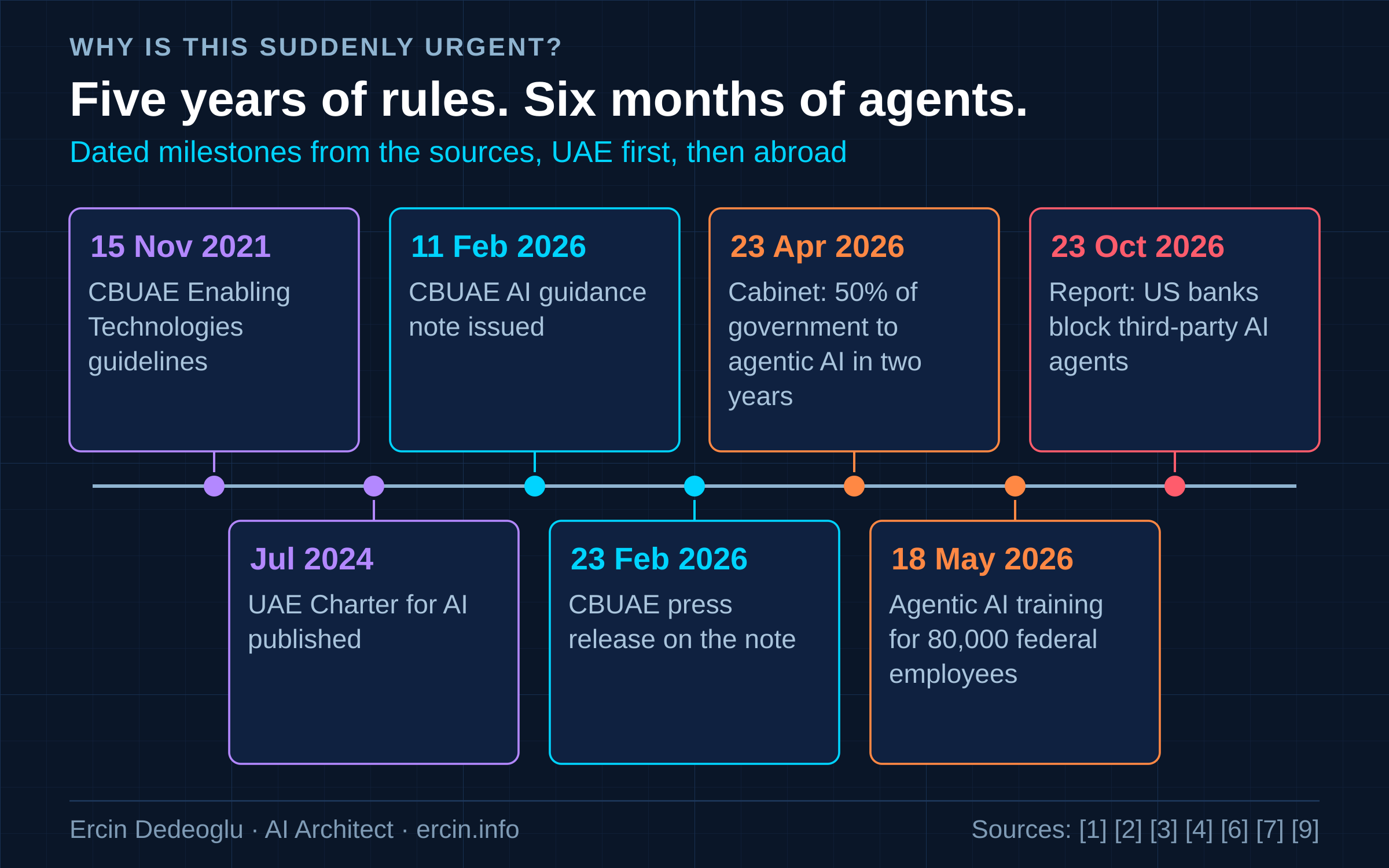
First, the government. On 23 April 2026 the UAE Cabinet announced a framework "aiming to transform 50% of UAE Government sectors and services within two years to Agentic AI for autonomous execution and decision-making" [3]. On 18 May 2026 the Cabinet approved training for 80,000 federal employees in agentic AI [4]. The official portal says the framework "mandates the use of Agentic AI in 50 per cent of government sectors, services and operations by 2028", and that a National Committee for Agentic AI launched a practical design guide (Arabic only) [5].
The Cabinet itself calls it a world first. Huge.
Second, the banks abroad. On 23 Oct 2026, Times of India, citing Reuters, reported that major US banks have been blocking third-party AI agents from customer accounts, and that in some cases customers had shared their login IDs and passwords with AI agents [6]. Shared passwords. With bots. DISASTER!
Here's the deal. Customers will show up with agents. Vendors will ship agents into your stack. The "Pilot First, Govern Later" crowd is about to get an expensive lesson.
Which Other UAE Rules Sit Next To The Note?
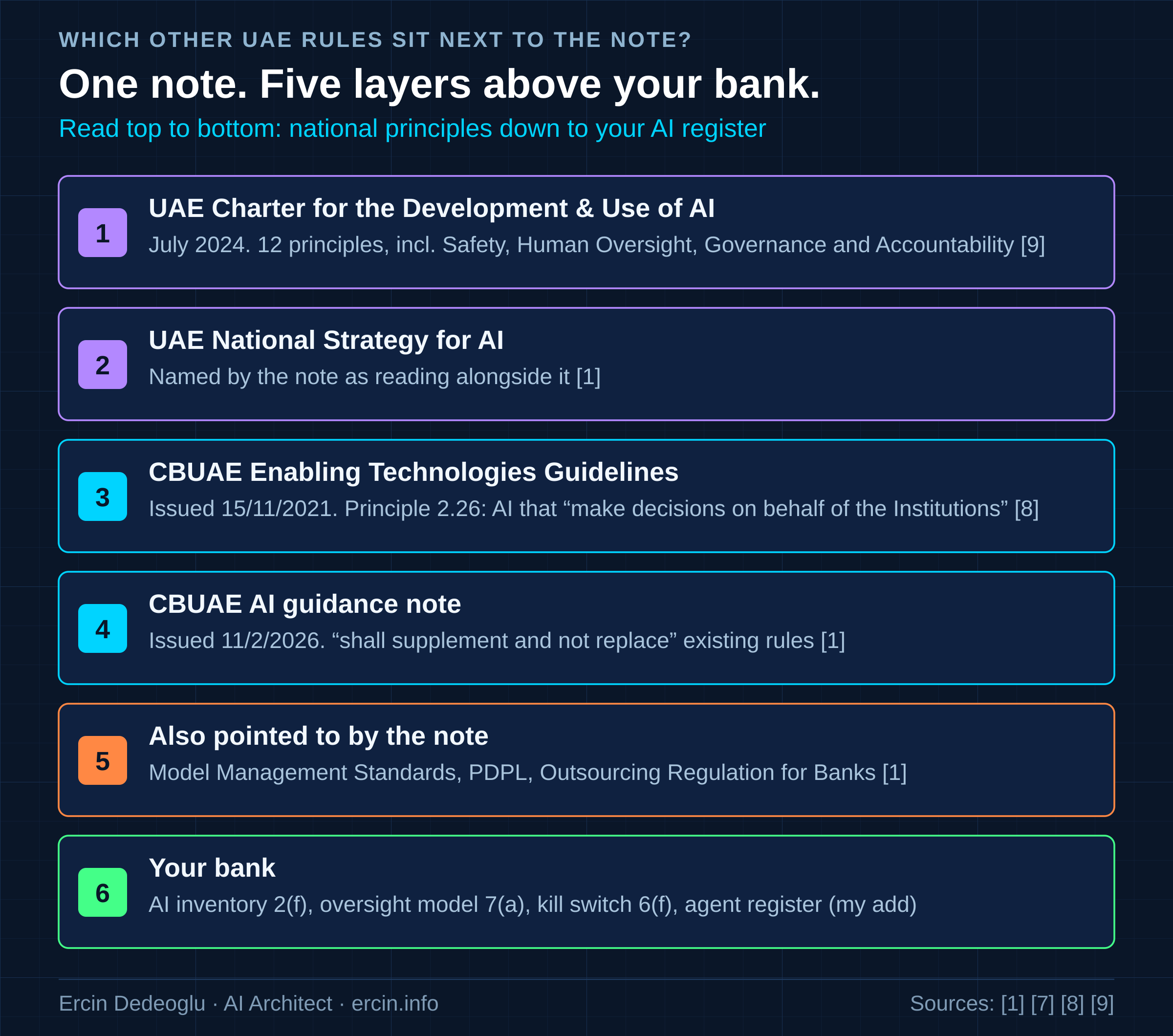
Folks, the note doesn't stand alone. It "should be read in conjunction with the UAE Charter for the Development & Use of AI, published in July 2024, the UAE National Strategy for AI, and the Central Bank Guidelines for Financial Institutions adopting Enabling Technologies" [1].
The Enabling Technologies Guidelines (issued 15/11/2021) carry the BEST line for agents [7][8]. Principle 2.26 says the governing body and senior management "should remain accountable for the outcomes and decisions of their Big Data Analytics and AI Applications including those Applications that make decisions on behalf of the Institutions" [8]. Decisions on behalf of the institution. Written in 2021. That's an agent, folks, before anyone called it one.
The UAE Charter lists twelve principles, including Safety, Human Oversight, and Governance and Accountability [9]. On safety it says the country "encourages modifying or removing systems that pose risks" [9]. On oversight it stresses "the irreplaceable value of human judgment and human oversight over AI" [9].
The note also points at the Model Management Standards, the UAE Personal Data Protection Law and the Outsourcing Regulation for Banks "to the extent applicable" [1]. A LOT of paper. All of it already yours.
Where Do Agents Break The Old Playbook?
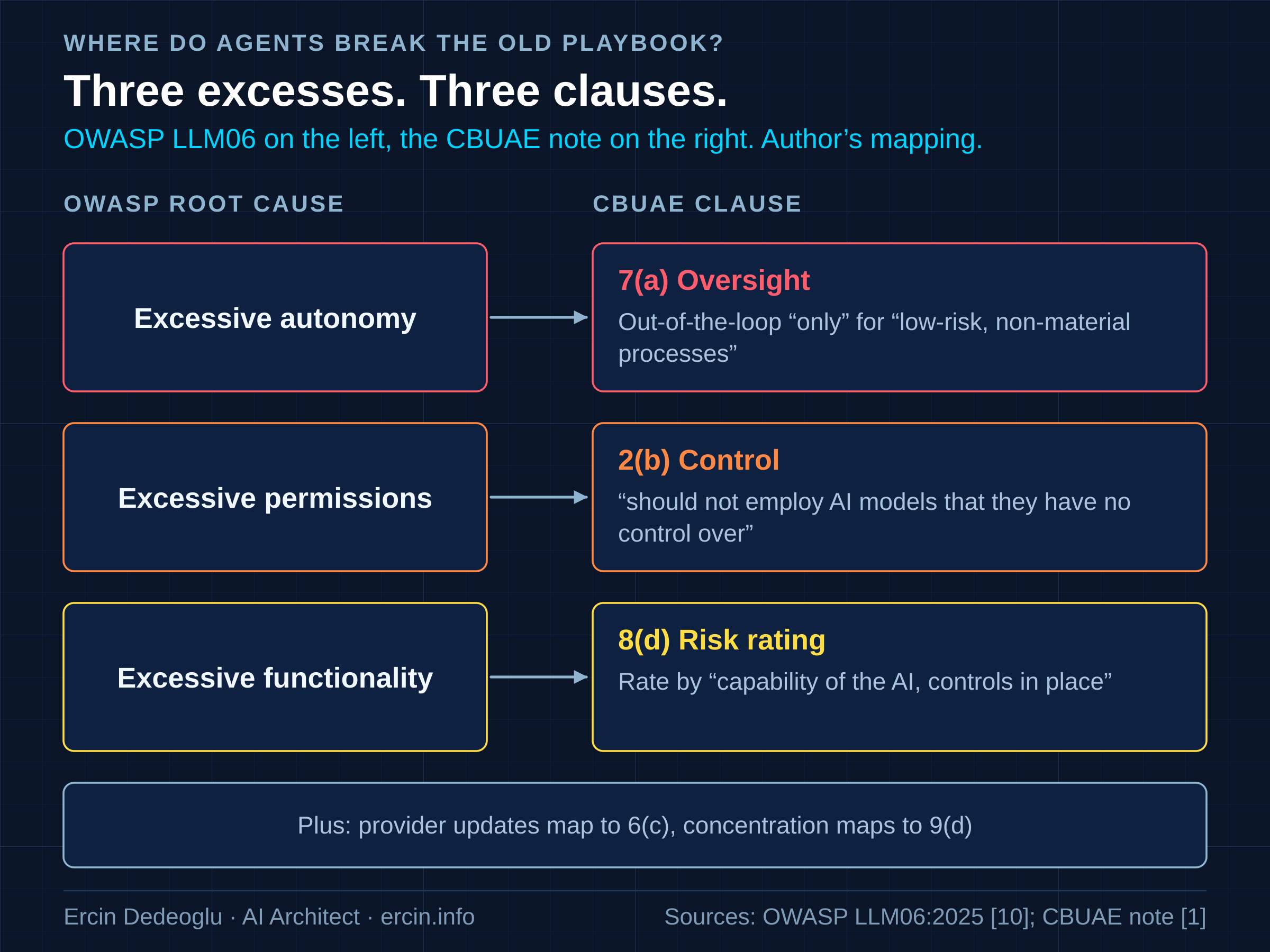
A chatbot talks. An agent ACTS. OWASP's LLM Top 10 2025 calls the failure mode Excessive Agency, and says its root cause is "typically one or more of: excessive functionality; excessive permissions; excessive autonomy" [10]. Three excesses. Every one of them is a governance decision, not a model problem.
Now line them up against the note. This is my mapping, not the CBUAE's text:
- Excessive autonomy meets 7(a). The note gives three oversight models. Human-out-of-the-loop "should only be utilised for low-risk, non-material processes with appropriate controls in place" [1]. An agent that moves money is NOT low risk. Period.
- Excessive permissions meet 2(b). "No control over" covers more than weights. If an agent holds a customer's shared password, who controls it? Nobody. Weak!
- Excessive functionality meets 8(d). The note wants each AI system risk-rated by "capability of the AI, controls in place, impact of the AI and dependence on the AI and/or third parties" [1]. Every tool you bolt on raises capability. Re-rate it.
- Provider updates meet 6(c). An agent framework that updates itself on Tuesday is a changed system on Tuesday. Test before implementation.
- Concentration meets 9(d). The note says to "consider and try to utilise a range of AI providers if feasible" [1]. One model vendor behind every agent? Risky.
The fix is boring and it works: Govern The Agent First. Then ship it.
What Goes On The Checklist?
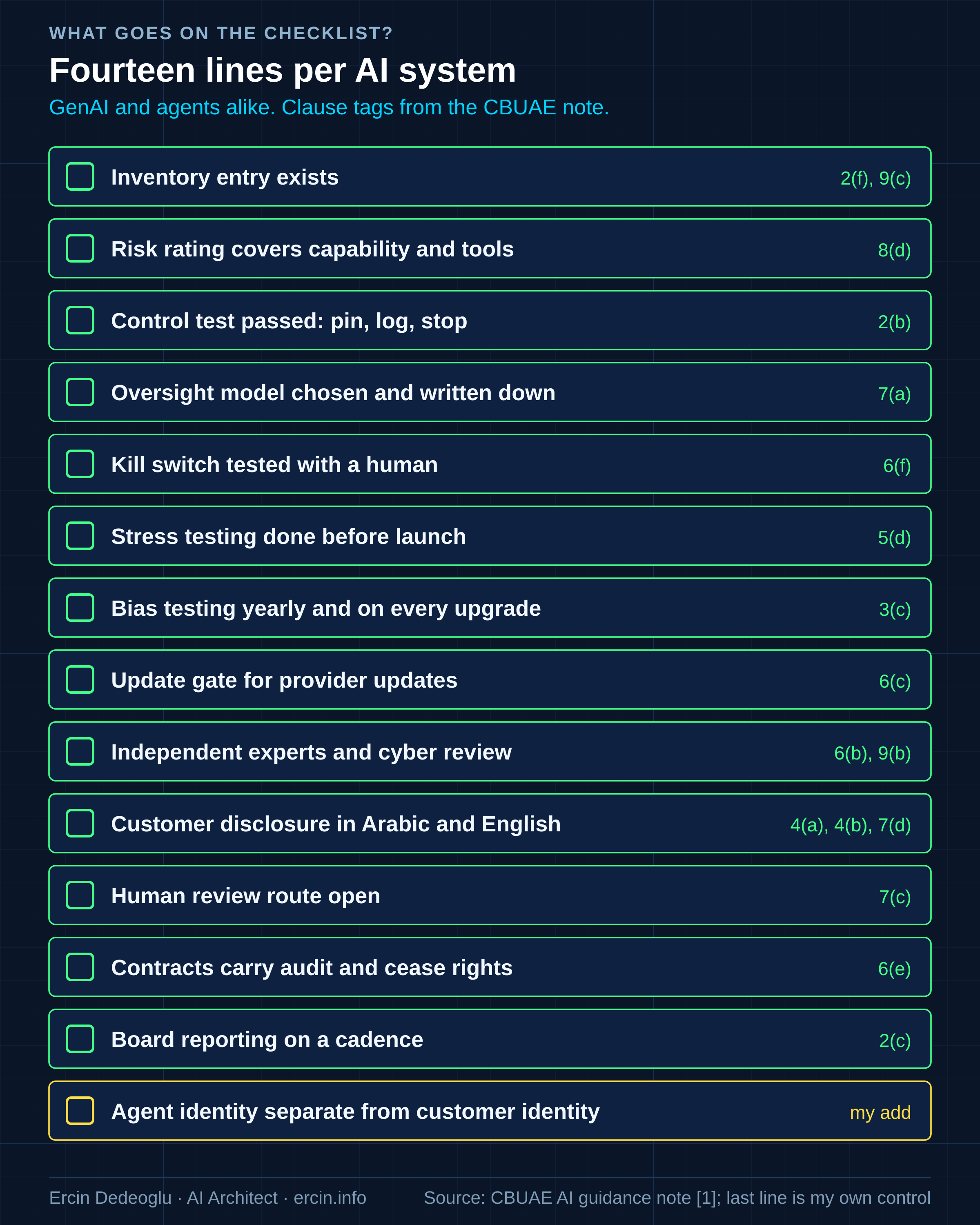
The part you print. Run it per AI system, GenAI and agents alike.
- Inventory entry exists. Model name, purpose, risk rating at minimum, third-party models included [1: 2(f), 9(c)].
- Risk rating covers capability and tools. Re-rate when an agent gains a tool or a permission [1: 8(d)].
- Control test passed. You can pin the version, log the calls and stop it. If not, you "have no control over" it [1: 2(b)].
- Oversight model chosen and written down. In-the-loop, on-the-loop or out-of-the-loop, with out-of-the-loop only for low-risk, non-material processes [1: 7(a)].
- Kill switch tested with a human. "Clear and immediate ability" to cease use, rehearsed, not assumed [1: 6(f)].
- Stress testing done before launch. Unsafe and unintended outputs, across scenarios [1: 5(d)].
- Bias testing scheduled. Yearly and on every upgrade, material change or new model [1: 3(c)].
- Update gate in place. Automatic provider updates tested before implementation [1: 6(c)].
- Independent challenge booked. Independent experts engaged periodically [1: 6(b)]; annual independent cybersecurity review for third-party AI [1: 9(b)].
- Customer disclosure live. Customers told they are dealing with AI, in Arabic and English, chatbots included [1: 4(a), 4(b), 7(d)].
- Human review route open. Customers can request human review and an alternative to the AI decision [1: 7(c)].
- Contracts carry audit and cease rights. Audit, information and termination provisions with AI providers [1: 6(e)].
- Board reporting on a cadence. Performance and risk, to senior management and the board [1: 2(c)].
- Agent identity separated from customer identity. No shared customer passwords in agent flows (my control, prompted by [6]).
Fourteen lines. One afternoon per system. Beautiful! For the architecture end, see my work as an AI architect in Dubai.
So Which Approach Should You Pick?
Two choices. Only two.
Option one: wait. Bolt agents on when a vendor demo looks shiny. Then explain to the risk committee why an agent did something no human approved. Not fun.
Option two: Govern The Agent First. Inventory. Rate. Pick the oversight model. Test the kill switch. Gate the updates. Book the independent challenge. Then let the agents in, one tool at a time.
Pick option two. The CBUAE already wrote the list. The government already set the clock. Read the homework before the agents arrive. Today.
About the author. I'm Ercin Dedeoglu, an AI Architect working on LLM, RAG and agentic systems for regulated banking. I write about sovereign, auditable AI at ercin.info. Related: LLM red teaming for banking in the UAE and sovereign GenAI for regulated banking.
Sources
- Central Bank of the UAE, Guidance Note on the Consumer Protection and Responsible Adoption and Use of Artificial Intelligence and Machine Learning by Licensed Financial Institutions in the U.A.E., CBUAE Rulebook, "Issued on 11/2/2026" (sections 1, 2(b), 2(c), 2(f), 3(c), 4(a), 4(b), 5(d), 6(b), 6(c), 6(e), 6(f), 7(a), 7(c), 7(d), 8(d), 9(b) to 9(d), closing text). https://rulebook.centralbank.ae/en/rulebook/guidance-note-consumer-protection-and-responsible-adoption-and-use-artificial-intelligence
- Central Bank of the UAE, press release "CBUAE Issues Guidance Note to Protect Consumers and Ensure Responsible Use of Artificial Intelligence in the Financial Sector", Abu Dhabi, 23 February 2026. https://centralbank.ae/media/41gjisn4/cbuae-issues-guidance-note-to-protect-consumers-and-ensure-responsible-use-of-artificial-intelligence-in-the-financial-sector-en.pdf
- UAE Cabinet, "Under directives of UAE President and in world first: Mohammed bin Rashid reveals new UAE government framework to deploy Agentic AI across 50% of government sectors, operations within two years", 23 Apr 2026. https://uaecabinet.ae/en/news/under-directives-of-uae-president-and-in-world-first-mohammed-bin-rashid-reveals-new-uae-government-framework-to-deploy-agentic-ai-across-50-of-government-sectors-operations-within-two-years
- Emirates News Agency (WAM), "UAE Cabinet, chaired by Mohammed bin Rashid, approves roles, responsibilities framework for federal ministries and entities in implementing Agentic AI Project", 18 May 2026. https://www.wam.ae/en/article/c09witr-uae-cabinet-chaired-mohammed-bin-rashid-approves
- The Official Platform of the UAE Government, "Agentic AI for Government Services" (page dated 30 Sep 2026). https://u.ae/en/about-the-uae/digital-uae/digital-technology/Agentic-AI-for-Government-Services
- Times of India (citing Reuters), "Why US banks, including JPMorgan and Morgan Stanley, are blocking AI agents from customer accounts", 23 Oct 2026. https://timesofindia.indiatimes.com/world/us/why-us-banks-including-jpmorgan-and-morgan-stanley-are-blocking-ai-agents-from-customer-accounts/articleshow/135131817.cms
- CBUAE Rulebook, "Key Principles for All Enabling Technologies", issued 15/11/2021, status In-Force. https://rulebook.centralbank.ae/en/rulebook/key-principles-all-enabling-technologies
- CBUAE Rulebook, "Big Data Analytics and Artificial Intelligence (AI)", Guidelines for Financial Institutions Adopting Enabling Technologies, principles 2.25 to 2.30, issued 15/11/2021. https://rulebook.centralbank.ae/en/rulebook/big-data-analytics-and-artificial-intelligence-ai
- The Official Platform of the UAE Government, "The UAE Charter for the Development and Use of Artificial Intelligence". https://u.ae/en/about-the-uae/strategies-initiatives-and-awards/policies/Ai/The-UAE-Charter-for-the-Development-and-Use-of-Artificial-Intelligence
- OWASP GenAI Security Project, "LLM06:2025 Excessive Agency". https://genai.owasp.org/llmrisk/llm062025-excessive-agency/